And what 15 years in the classroom taught me about working smarter
Real Classroom AI | AI for Primary Teachers | Classroom Practice
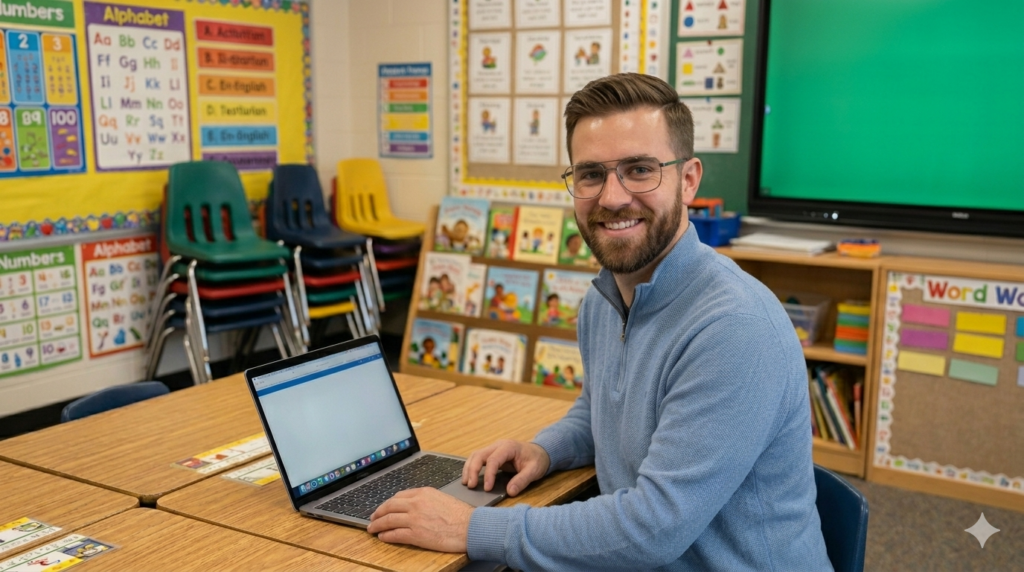
Let me be honest with you. I didn’t start this site because I love technology. I started it because I was exhausted. After 15 years of teaching — across Reception to Year 6, in both Australia and the UK — I found myself spending more time at my desk creating resources than I was spending in front of my class. And that felt wrong. Deeply wrong.
Teaching is a job you do for the moments. The moment a child finally grasps a concept they’ve been wrestling with for weeks. The moment a reluctant reader gets lost in a book. The moment a classroom full of children is so engaged that you forget to watch the clock.
But those moments don’t happen by accident. They happen when teachers have the time and energy to plan great lessons, to know their pupils well, and to show up fully present. When you’re buried in paperwork until 10pm, that presence is the first thing to go.
That’s what led me to explore AI for primary teachers — and eventually to create Real Classroom AI.
I wasn’t looking for a shortcut. I was looking for a way to give my best to the children in my classroom — and AI turned out to be the tool that made that possible
The classroom has changed and the workload just keeps growing
If you’ve been in teaching for any length of time, you’ll know that today’s classroom looks very different from even a decade ago.
The children we teach arrive at school with an increasingly wide range of needs — academic, social, emotional and everything in between. Inclusive education is absolutely right, and I believe in it wholeheartedly. But the reality is that supporting every child effectively takes an enormous amount of preparation.
Creating differentiated resources for a class of 30 — where some children are working below expected level, some have EAL needs, some have SEND support plans, and a handful are flying ahead — is one of the most time-consuming parts of the job. And it has to be done well.
Because here’s what I’ve learned: when children can’t access the work on their desk, they don’t sit quietly and wait. They disengage. And when children disengage, behaviour follows. I’ve seen it play out countless times — and it’s almost never about attitude. It’s about access.
So I kept asking myself: is there a better way to make sure every child in my class gets what they need, without it costing me every evening and weekend?
Then I started experimenting with AI for primary teachers
Like most teachers, my first instinct was scepticism. I’d seen plenty of ‘revolutionary’ tools come and go. I wasn’t looking for another thing to add to my plate.
But I started experimenting — cautiously, critically — and something shifted.
The first time I used AI to differentiate a worksheet that would normally have taken me 45 minutes, and it took me four, I didn’t celebrate immediately. I checked it carefully. I edited it. I questioned it. But it was genuinely good. Really good.
And then I started thinking about everything else I spent hours on that AI could help with. Lesson planning. Report writing. Creating resources for different ability groups. Generating discussion questions. Writing scaffolds for children who needed extra support. The list grew quickly.
| AI doesn’t plan my lessons. I do. AI just means I spend less time on the parts that don’t require my expertise — so I can spend more time on the parts that do. |
What I discovered was that AI for primary teachers is only genuinely useful once you understand how to use it effectively. Vague prompts produce vague results. But when you give AI the right context — the year group, the ability level, the learning objective, the curriculum framework — the output becomes something you can actually use in a real classroom. With real children.
That learning curve is exactly what Real Classroom AI is here to help with.
Why I created Real Classroom AI
Once I saw how much time AI was saving me — and more importantly, how much better I felt walking into my classroom because I wasn’t running on empty — I wanted to share it.
Not in a theoretical way. Not with a vague list of tools. But in a real, practical, honest way. Here’s the prompt I used. Here’s what came out. Here’s what I changed. Here’s how I used it with my class on Thursday.
Because that’s what teachers actually need. We don’t have time for theory. We need to know: does this work? And if so, exactly how?
My goal with Real Classroom AI is simple. I want every teacher who watches a video or reads a post here to finish it with something they can use tomorrow. A prompt they can try. A strategy they can apply. Time they get back.
And I want to show that using AI well doesn’t mean less teacher involvement — it means better teacher involvement. When every child can access the learning, something remarkable happens. Engagement goes up. Behaviour improves. Confidence grows. And the classroom becomes the place it should always be — somewhere every single child experiences success.
| When I’m not spending Sunday afternoon making three versions of the same worksheet, I’m thinking about how to make Monday’s lesson brilliant. That’s the real point of AI for primary teachers. |
Who this content is for.
If you’re a primary teacher who is curious about AI but not sure where to start — this is for you.
If you’re a supply teacher who wants ready-to-use, reliable resources — this is for you.
If you’re a school leader trying to understand what AI means for your staff and your pupils — this is for you.
And if you’re a parent wondering what AI in the classroom actually looks like day to day — this is for you too.
You don’t need to be a tech expert. You don’t need expensive tools. You just need to be willing to try something new — and I’ll walk you through every step.
I’m so glad you’re here. Let’s work smarter — so we can teach better.
Get the full set of prompts — free
Download the free guide: 10 real ways primary teachers are using AI right now
You can also invest in my new e-book The AI Ready Teacher . Find out more here