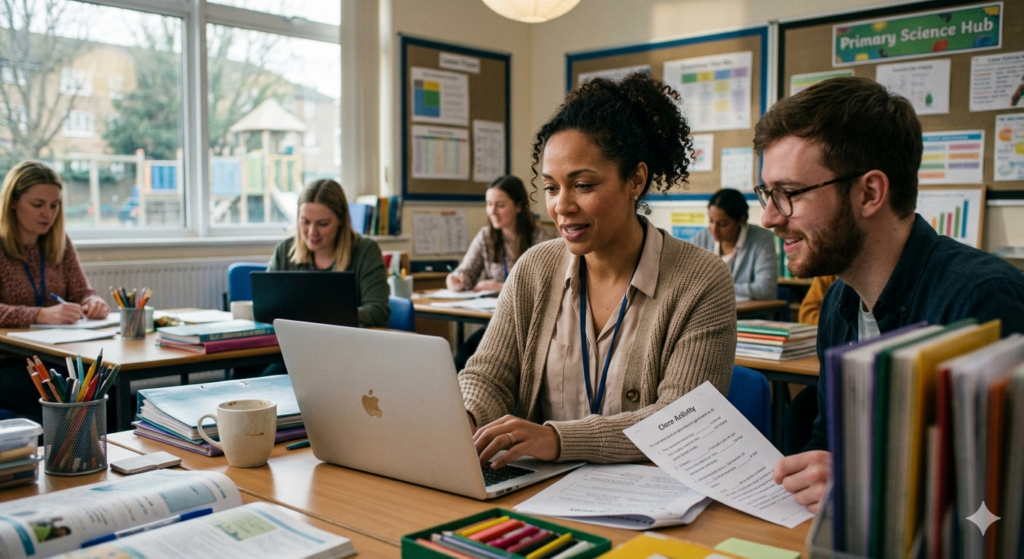
I didn’t get into teaching to spend my Sunday afternoons making three versions of the same worksheet. Nobody did. But for a long time, that’s exactly where my energy was going — and I know I’m not alone in that.
The “Sunday Night Blues” are real. For most primary teachers, they’re not caused by the job itself — they’re caused by everything that surrounds it: the differentiation, the scaffolding, the resource creation, the endless adaptation of materials for thirty children with thirty different starting points. We love the classroom. We’re just chronically exhausted by the time we get there.
So when I started experimenting with AI — cautiously, sceptically, the way most teachers do — I wasn’t looking for a shortcut. A way to give my best to the children in front of me was what I was after. And something shifted.
What actually changed for me
The first time I used AI to differentiate a resource that would normally have taken me 45 minutes, and it took me four, I didn’t celebrate. I checked it carefully. Then edited. Then questioned every line. But it was genuinely good — usable in a real classroom, with real children.
“AI doesn’t plan my lessons. I do. AI just means I spend less time on the parts that don’t require my expertise — so I can spend more time on the parts that do.”
That’s the shift that matters. Not the technology. The time. Because when you’re not running on empty by 9am Monday morning, everything changes — your presence in the room, your ability to read the class, your capacity to notice the child who’s struggling rather than just pushing through the next slide.
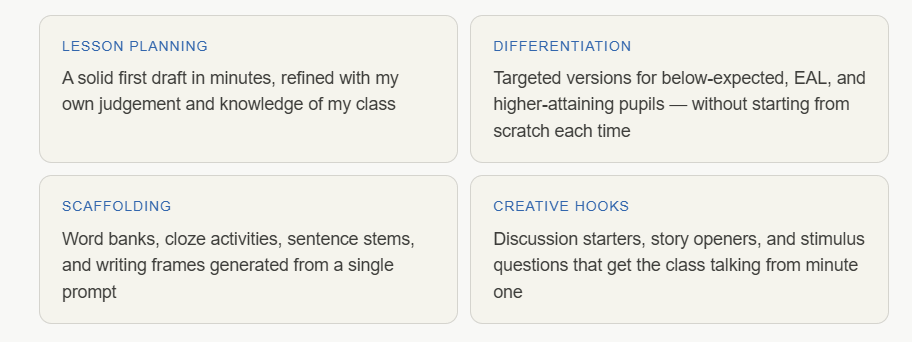
Keeping a rough mental note of what AI was helping with, the list grew quickly.
What I noticed in the classroom
Here’s the thing nobody tells you about getting the preparation right: it changes the behaviour in the room.
When children can’t access the work on their desk, they don’t sit quietly and wait — they disengage. And disengagement rarely stays quiet. Arriving at lessons with resources every child could genuinely reach — not just the middle group — shifted something in the room. Engagement went up. Confidence grew. The children who used to opt out started opting in.
That’s not an AI story. That’s a teacher story. AI just gave me back enough time and energy to make it happen.

The part that took me by surprise
Getting time back was the goal. Feeling like a better teacher was the surprise.
Not because AI was doing my job — but because burnout was no longer the starting point for every week. Monday’s lesson could be something brilliant, rather than just something to survive. Small things about my pupils — things I’d been too tired to catch before — started coming back into focus.
That presence — being genuinely in the room — is the reason most of us went into teaching. It’s also the first thing to go when the workload tips over the edge. Getting it back felt significant.
What this means for primary schools
One thing worth being clear about: AI for primary teachers only becomes genuinely useful once you understand how to use it well. Vague prompts produce vague results. Give AI the right context — the year group, the ability level, the learning objective, the specific need — and the output becomes something you can actually use on Thursday morning.
That learning curve is exactly what Real Classroom AI exists to shortcut. Not another tool to figure out alone — but a clear, practical guide: the prompt, the output, what changed, how it played out with a real class.
Because that’s what teachers actually need. Not theory. Not a tool list. The real thing.
If you’re a primary teacher curious about AI but unsure where to start — this is where to start.
Get the full set of prompts — free
Download the free guide: 10 real ways primary teachers are using AI right now
You can also invest in my new e-book The AI Ready Teacher . Find out more here