Here’s what changed my mind.
Real Classroom AI | AI in the Classroom | Primary Teaching
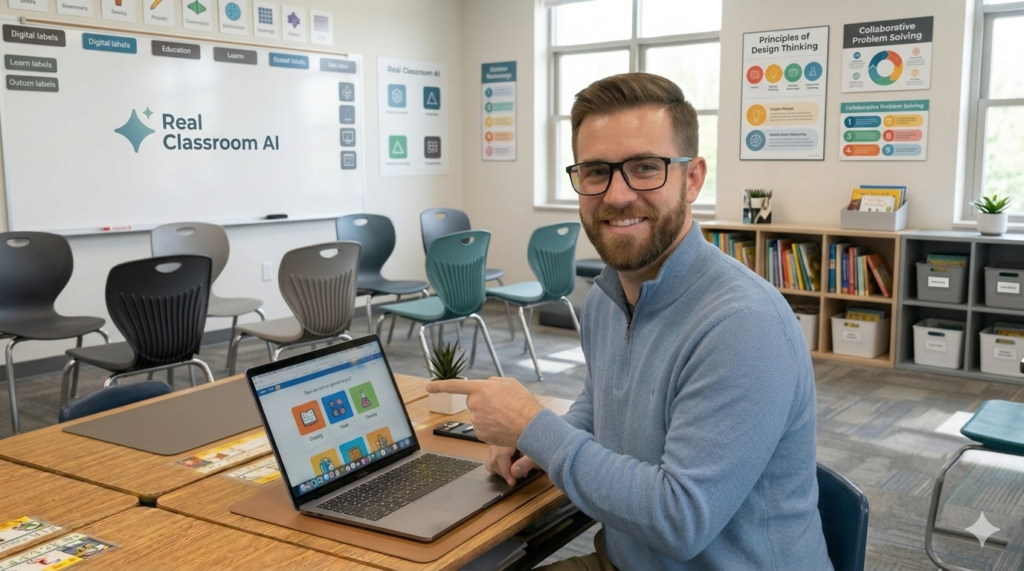
If you’d told me two years ago that AI in the classroom would become part of my daily teaching practice, I would have given you a polite smile and gone back to my marking.
I had real concerns. Not vague, uninformed ones — specific, professional ones. I didn’t believe AI could handle the complexity of a real classroom. And I was genuinely worried about data privacy and what it meant ethically to bring these tools into a school setting.
I wasn’t being difficult. I was being a responsible teacher. And I think if you’re reading this with similar reservations, you probably are too.
But something changed. Actually, several things changed. And in this post I want to be completely honest about what those concerns were, what shifted them, and what I still hold onto today.
I wasn’t an early adopter. I was a sceptic who eventually ran out of reasons not to try it — and what I found genuinely surprised me.
Concern one: AI can’t handle the complexity of a real classroom
Of all my reservations, this felt the most legitimate — and honestly, it still does to some extent.
A primary classroom is not a spreadsheet. Thirty children arrive every morning with their own histories, their own relationships with learning, their own needs. Some children shut down when a task feels too hard. Others need instructions delivered differently before something clicks. A child’s behaviour on any given day can hinge entirely on what happened at home before school.
No algorithm understands any of that. My real doubt was whether AI could produce resources that served the full range of learners in my class — not just the middle, but the extremes, including my SEND and EAL pupils who needed something very precise.
The shift came when I stopped imagining AI as something that works on its own, and started using it as something that works with me.
Giving the tool the full picture made all the difference — the year group, the topic, the learning objective, the specific ability levels, the particular needs of my SEND and EAL learners. The output that came back used my professional knowledge as its foundation and built something useful from it in a fraction of the time it would have taken me alone.
The lesson plan worked with my class. The differentiated resources for my SEND and EAL pupils were properly scaffolded — far better than I had expected. That result genuinely surprised me.


I had pictured AI working instead of me. What I actually found was something that worked with me — and that distinction changes everything.
Concern two: data privacy and the ethics of AI in schools
This concern has not gone away, and I think it shouldn’t.
Working with children — especially those with additional needs or complex backgrounds — carries a professional and moral obligation to think carefully about any third-party tool that touches their data.
My approach now follows a simple rule: personally identifiable information about children never goes into any AI tool. No names, no specific details that could identify a pupil. Learner needs go in as general descriptions — ‘a child working below expected level who benefits from visual scaffolds’ rather than anything linked to an individual.
Taking time to read the privacy policies of the tools you use also matters enormously. Some AI platforms have education-specific data agreements in place. Others do not. Knowing the difference is part of using these tools responsibly.
A full post on navigating data privacy in AI is coming soon — but I wanted to address it here rather than skip past it, because dismissing this concern does teachers a disservice. Your caution is right. The goal is to become informed, not to avoid the tools entirely.
The four things that actually changed my mind
The shift happened over a few weeks, and four specific experiences drove it.
First came the time. During a particularly heavy planning week — multiple subjects, several children with individual learning needs, a whole-class assessment to prepare — using AI for differentiation saved hours, not minutes. That Sunday afternoon became a Sunday morning, and walking into Monday with genuine energy felt like something I hadn’t experienced in a long time.
Second came the quality. Generic, bland output was what I had expected — the kind of could-be-any-classroom resource that fills up free download sites. Instead, with a well-constructed prompt, the output was specific, curriculum-aligned and genuinely usable. Editing from a strong starting point turns out to feel very different from building everything from scratch.
Third came the SEND and EAL support. Doubting this most, I found it the most compelling. Properly scaffolded adaptations for my EAL pupils, genuinely differentiated tasks for my SEND learners — the AI used the detailed context I gave it well. This result did more to change my thinking than anything else.
Fourth came the lesson that worked. Asking AI to help plan a lesson from scratch, providing full context, and then watching it land with my class — that was the moment the tool stopped feeling like an experiment.
Hours back on differentiation, a lesson that genuinely worked, SEND adaptations that held up in the classroom — these were not small wins. They were the proof I needed.
What I want you to take from this.
AI in the classroom is not perfect, and your concerns are not wrong. Both of those things are true at the same time.
Classroom complexity and data ethics are serious considerations. Both have workable answers — but those answers require thought, care, and a commitment to staying critical. Dismissing the tools entirely is one response. Learning to use them responsibly is another.
For any teacher who is exhausted, spending evenings creating resources that take far longer than they should, and wanting to do better by their SEND and EAL learners — AI in the classroom deserves a serious look. Not a breathless, uncritical one. A serious one, with professional judgement switched on throughout.
That approach is exactly what Real Classroom AI is built around. Every post and video here comes from a real classroom, with real children, and an honest account of what works and what doesn’t.
Want the full backstory? Head to my first post — Why I Started Real Classroom AI — for everything that led to this.
Get the full set of prompts — free
Download the free guide: 10 real ways primary teachers are using AI right now
You can also invest in my new e-book The AI Ready Teacher . Find out more here