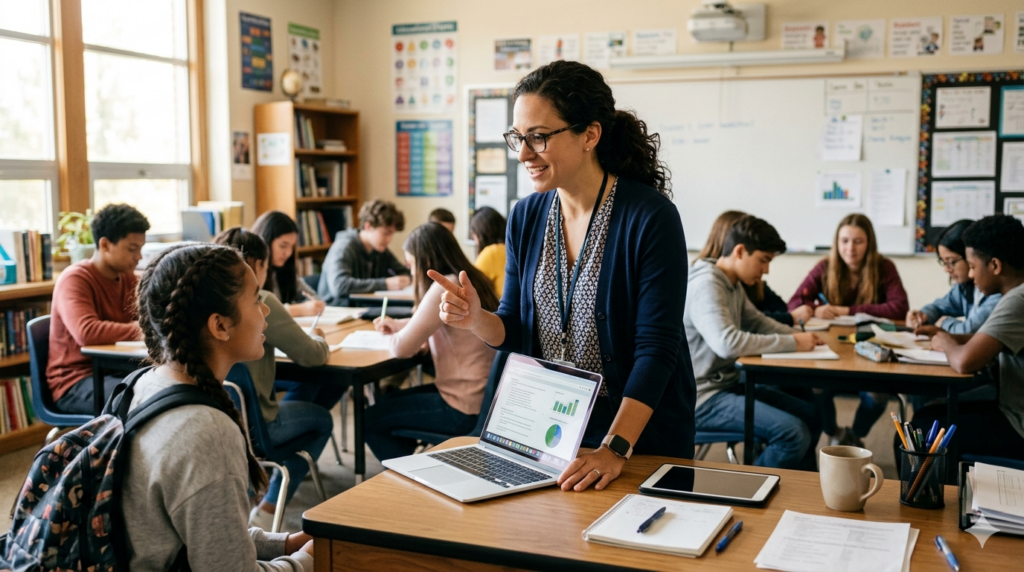
Artificial intelligence is becoming a regular part of many teachers’ working lives.
Whether you’re using ChatGPT to generate lesson ideas, create differentiated activities, draft parent communications or save time on planning, there’s no doubt that AI can be a powerful tool.
But as AI becomes more accessible, I’ve noticed a growing concern among teachers.
Not “Will AI replace teachers?”
More often, the question is:
“Am I using AI responsibly?”
As someone who uses AI regularly, I believe it has enormous potential to reduce workload, spark creativity and support great teaching. However, I also think there are some important boundaries we should all follow.
Here are five rules I never break when using AI as a teacher.
1. Never Upload Identifiable Pupil Information
This is the big one.
AI tools can be incredibly helpful, but they should never be given access to confidential pupil information.
That means avoiding:
- Student names
- Assessment data linked to individuals
- SEND information
- Safeguarding details
- Personal information about pupils or families
- School documents containing identifiable data
If I want help drafting a report comment or creating differentiated activities, I remove all identifying information first.
Protecting pupils’ privacy must always come before convenience.
2. Treat AI as an Assistant, Not a Replacement
One of the biggest misconceptions about AI in education is that it can somehow replace professional expertise.
It can’t.
AI can generate ideas.
It can suggest activities.
It can help structure content.
But it doesn’t know your class.
It doesn’t understand the needs of the child who struggles with reading but excels in science. It doesn’t know which explanation finally clicked for your reluctant learner last week.
Teaching is built on relationships, observation and professional judgement.
AI can support those things. It cannot replace them.
3. Fact-Check Everything
AI is incredibly confident.
Unfortunately, it’s not always correct.
I’ve seen AI invent historical facts, misquote sources, create maths questions with incorrect answers and confidently provide information that simply wasn’t true.
That’s why I never copy and paste AI-generated content directly into the classroom.
Before using anything produced by AI, I check:
- Facts and figures
- Historical information
- Scientific explanations
- Assessment questions
- Reading texts
- Suggested websites and resources
The time AI saves isn’t worth much if you’re teaching inaccurate information.
Always review before you use.
4. Make It Your Own
The best use of AI isn’t asking it to do your job.
It’s asking it to help you do your job better.
When I generate lesson ideas, worksheets or explanations, I treat them as a starting point rather than a finished product.
I adapt.
Refine.
I personalise.
I make them suitable for my pupils.
That’s where the real value lies.
The magic doesn’t happen when AI creates something. It happens when an experienced teacher improves it.
Your expertise is still the most important ingredient.
5. Keep the Human in the Loop
Perhaps the most important rule of all is this:
You remain responsible for the final outcome.
If an AI-generated worksheet contains an error, the responsibility doesn’t belong to the AI.
Know that if a parent email contains inappropriate wording, the responsibility doesn’t belong to the AI.
Remember, if lesson content is inaccurate, the responsibility doesn’t belong to the AI.
It belongs to the person who chose to use it.
That’s why I believe every teacher should remain firmly “in the loop” when using AI.
Use AI to support your thinking.
AI can save you time.
Use AI to generate ideas.
But never hand over your professional judgement.
Final Thoughts
I genuinely believe AI can be one of the most useful tools teachers have gained in years.
Used well, it can help reduce workload, generate fresh ideas and free up more time for the parts of teaching that matter most.
But responsible AI use in schools isn’t really about technology.
It’s about professional judgement.
The teachers who will benefit most from AI won’t be the ones who use it for everything.
They’ll be the ones who know when to use it, when to question it and when to rely on their own expertise instead.
That’s why these five rules aren’t really about AI at all.
They’re about being a thoughtful, responsible professional in an increasingly digital world.
Get my full set of AI for Teachers prompts — free
Download the free guide: 10 real ways primary teachers are using AI right now
You can also invest in my new e-book The AI Ready Teacher . Find out more here